Physical Address
304 North Cardinal St.
Dorchester Center, MA 02124
Physical Address
304 North Cardinal St.
Dorchester Center, MA 02124
Through Zanyar Omrani’s documentary Solitary Confinement, Awat Poury traces the connections between imprisonment, the siege of Sanandaj and pandemic quarantine. Drawing on Youssef Ardalan’s memories, archival images and the nurses’ struggles in France, the article revisits the violence of 1979–80 in Kurdistan and examines how official media narratives erased democratic demands and medical workers’ resistance.
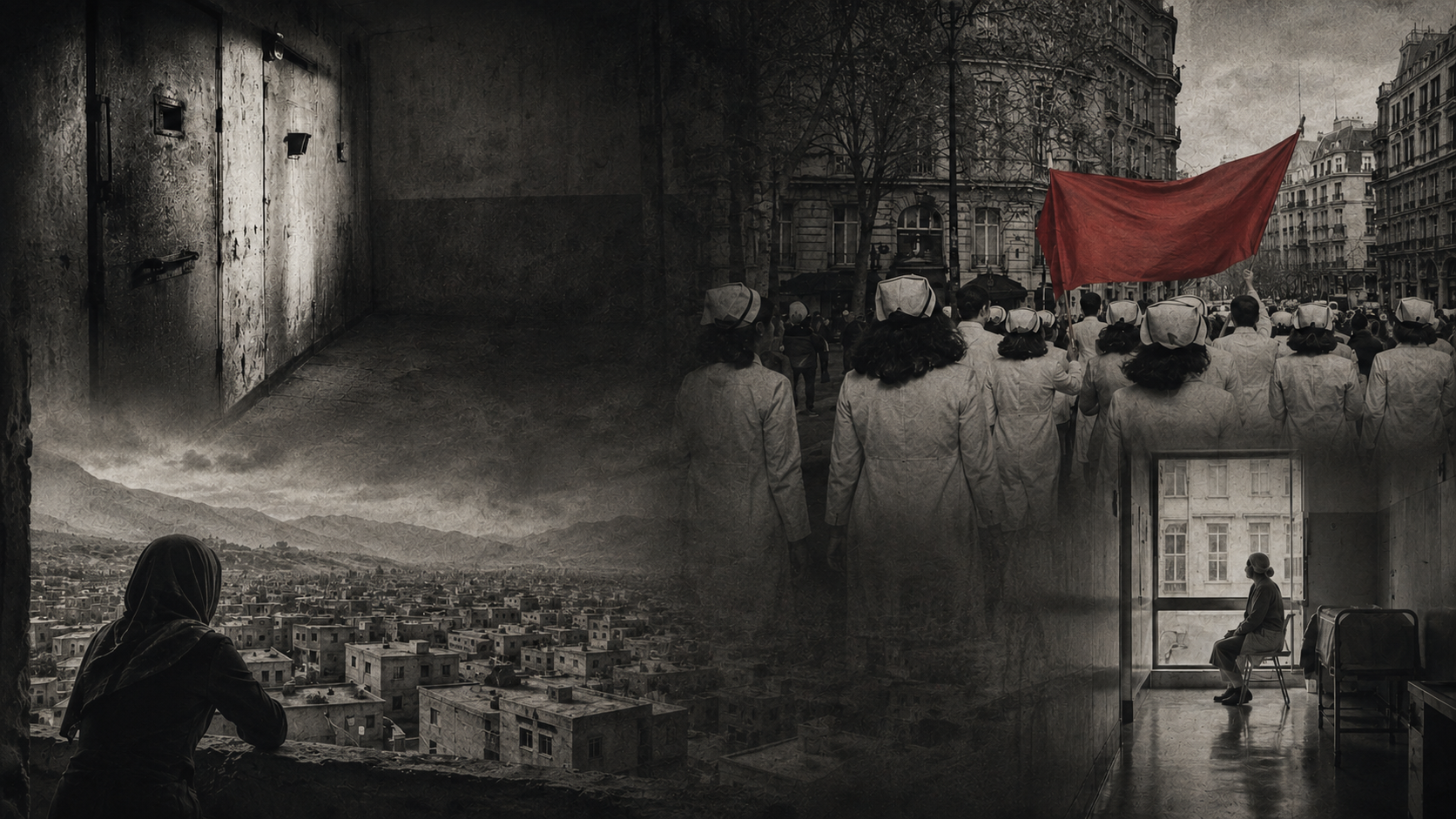
The movie begins with images of nurses striking in France quarantine general atmosphere period and the voice of a French TV channel reporter about the danger of the corona(covid_19) outbreak in prisons. The sound and video both evoke the coldness and distance of the quarantine for the audience, and this continues with Youssef Ardalan’s narration on solitary confinement during the reign of Mohamad Reza shah pahlavi. The sound of Quarantine exile in France along with images of the situation seems to provide instruction on how to spend time in quarantine, as it did in prison with charcoal chess. The images of the film in a grey space with bright white light, slow-motion movements and emphasis on black and white colour also somehow evoke the process of making charcoal chess. At the same time, the warm and patient voice of Youssef Ardalan rebuilds the chess pieces one by one and provides a picture of resistance of Sanandaj in those days.
Confinement comes from Latin roots. It is being used for Quarantine in the contemporary French language while it means imprisonment in English. The name of the movie refers to the three concepts of imprisonment, blockade and quarantine from the perspective of three languages, Persian, French and English. Zanyar Omrani’s recent works as an exiled Kurdish filmmaker has been an attempt to understand the commonalities and differences between popular movements in Kurdistan, Iran and the Middle East and their links to the current movements in France, where he now lives. These films all have a socio-political perspective that emerges from the daily life of an asylum seeker in France and his attempt to connect it with contemporary movements. <Solitary confinement> is a continuation of Zanyar Omrani’s work in the short film of “Mask“. The Mask is a different experience of facing Quarantine and social distancing through the camera and assembly respectively.
“Solitary confinement,” retells the memories of Youssef Ardalan from two periods of his life. “Three months of solitary confinement in Ghezel Ghaleh prison in Tehran” during the regime of Mohammad Reza Shah Pahlavi and “siege of Sanandaj” in the post-revolutionary period of 1979. It seems that the burden of those memories makes the current situation bearable.
Youssef Ardalan says that after his release from solitary confinement and the formation of popular protests in November 1978, he returned to Sanandaj to play a role in these developments. But he never knew that this journey was a passage from solitary confinement to an unforeseen siege. He was a member of the elected councils of the people of Sanandaj. The members of this council were elected by direct popular vote. They later formed 55 local councils to run the city. They were called “Binke”. These Binkes organised people for medical, service, cultural, and political affairs. It can be said that the most important achievement of the events of the early days of the revolution in Kurdistan was the city council. This council in Sanandaj paved a new way to a different urban management. Youssef Ardalan won 12,230 votes as a member of the council and was elected along with Fouad Rouhani, Jabbar Arianjad, Hadi Moradi, Mullah Mahmoud Ahangar, Marouf Sheikhi and Farideh Ghoreishi. “
“Kurdistan has declared independence,” Iranian national television announced on Monday, February 19th, 1979. Although this was the first propaganda campaign against popular movements in Kurdistan after the fall of Mohammad Reza Shah, it was not the last, and it was repeated, by government officials, newspapers and radio And the TV until June 1980 when Kurdistan was repeatedly ransacked. This approach has continued up until now. The latest example is the silence of civil society and the Iranian medias in diaspora over the execution of two Kurdish political activists, Saber Sheikh Abdullah and Diako Rasoulzadeh, during the “Do not execute” campaign, which was a campaign to prevent the execution of three protesters sentenced in December 2020.
“Solitary confinement” tries to have a quick look at the events of those days by showing unseen and less seen photos from that period. No matter how slow the narration of Youssef Ardalan resulting from being in quarantine is, fast and constant images come and go. This speed and slowness are tied with the rhythmic beats of the film’s music, which is a work of “Roozbeh Mosleh“, and give a certain rhythm to the film. He was inspired from the song “Xiyaban Xirosawe” by “Kale Atashi”. Roozbeh Mosleh is a young composer who spent his childhood in Sanandaj during the dark years of the 80s. Therefore, his lived experiences apply to the film in the form of the pieces he has made and are in complete harmony with it.
The New York Times reported on August 19, 1979: “Iranian Government forces converged on the Kurdistan capital, Sanandaj, today after Ayatollah Ruhollah Khomeini ordered general mobilization to crush what he called a Kurdish rebellion there.”
Two days before the news was published, Ayatollah Khomeini had said during a speech in Qom: “These conspirators are among the infidels”. These conspirators are in Kurdistan and the ranks of infidels. They must be dealt with severely. The government should act harshly, The gendarmerie act harshly. The army act harshly. “If they do not treat them harshly, we will treat them harshly.”
“Chris de Crester,” wrote in a report from the speech for the Washington Post on August 19, 1979: ” Ayatollah Rubhollah Khomeini today declared himself military commander-in-chief and gave the country’s armed forces 24 hours to crush a Kurdish rebellion or face the wrath of the revolution…. He issued a ultimatum, which expired at 1 p.m. warning the Kurds that if they did not end their rebellion, troops and Revolutionary Guards from throughout Iran would destroy them.”
On August 19, Ayatollah Khomeini’s message along with a military march was repeatedly broadcast on radio and television: Breaking news reported that in Sanandaj, the “Democratic Party (PDKI)” had surrounded the armies and their organizations, and would cut off their weapons if help did not arrive within half an hour. And we have been informed from the Sanandaj mosque that the Democratic Party has taken our women as hostages. I strongly instruct all law enforcement forces to inform the barracks of the centres to move towards Sanandaj, and to suppress the miscreants severely. The Revolutionary Guards, wherever they are, should mobilize enough towards Sanandaj and Kurdistan _by air bridge_ and suppress all the miscreants severely. Delay – even for an hour – is a breach of duty and is severely prosecuted. I call on the Iranian people to be careful to report any violations that they have committed immediately. I expect to receive the news of a general mobilisation from the police in another half an hour.”
The fire of war in Kurdistan was flamed more seriously than before following this decree. On the first day after Ayatollah Khomeini’s fatwa was issued, 12 people were shot dead in the city of Paveh on charges of “participating in riots and clashes” by order of Sadegh Khalkhali, the religious judge of the revolutionary courts. Dr. “Abolghasem Rashvand Sardari” was one of these 12 people, a picture and a short biography of him is shown at the end of “solitary confinement”. The war and killing started from Paveh and reached Sanandaj, Mariwan and Saghez and continued to Bukan, Mahabad and Piranshahr. Cities whose wounds have not yet healed after more than forty years because this unequal war is being imposed on them differently each time.
On August 31, 1979, Ayatollah Mahmoud Taleghani, in his Friday prayer sermons at the University of Tehran, supported the fatwa on the attack on Kurdistan in a sharper and more hostile tone, simply stating the reason was the entire boycott of the Islamic Republic referendum in April 1979: “Those who said right from the beginning that we do not vote for the Islamic Republic, they practically separated themselves from 98% of the Muslim people of Iran, you don’t vote? So what do you want? What does it mean for a religious cleric (Sheikh Ezzadin Husseini) to say that he does not vote for the Islamic Republic? Jews voted, Christians voted, Zoroastrians voted … What does it mean when a religious cleric says I will not vote? This nation does not tolerate, the Qur’an does not tolerate, the Qur’an also says that wherever there is sedition, you must kill … “We all depart, but Khomeini departs too.” Ayatollah Taleghani’s remarks came as he was a member of the “Goodwill Committee” to resolve the Kurdistan issue, which was sent to Sanandaj in April 1979.
This part of Ayatollah Taleghani’s remarks can be considered as the aggrieved part of the film. Because it reminds of a critical moment when the so called “most moderate” political centralized forces also stood by Ayatollah Khomeini and denied the possibility of any dialogue. Which can no longer be considered a simplistic misunderstanding Because the shadow of these relations is still covering the Kurdish and Iranian opposition forces. The Kurdish forces at that time believed that within the framework of Iran’s geography, one could seek a form of self-determination.
Apparently, none of these forms had a place in the dictionary of the rulers of the time of the Islamic Republic and the Iranian opposition. It is an approach that has been least criticized by the Iranian opposition, as “Abolhassan Banisadr”, the then President of Iran still defends the invasion of Kurdistan under the pretext of “preserving territorial integrity.” Which gives the people of Kurdistan the right to always have this question in mind: “In a similar situation, would Iranian opposition forces again shirk from taking responsibility for the fate of the people of Kurdistan and would these people witness the opposition complicity with the repressive forces?”
The “solitary confinement” is an intensive review of these belligerent statements and the fabricated narratives of the newspapers of the time. The voices of Ayatollah Taleghani and Khomeini follow each other with headlines from the newspapers such as ‘’Engelabe Eslami’’, ‘’Etela’at’’, ‘’Jomhorie Eslami’’ and ‘’Keyhan’’. The advancement of the army, the occupation of Kurdistan, the shootings, the fall of the invaders’ strongholds, the collection of bodies from the streets of Sanandaj, the clearing of the mountains and caves of Kurdistan, the negotiations of Kurdistan were stopped and set on fire and blood, They want to eradicate Islam from Kurdistan, Bloody catastrophe in Kurdistan, Mu’awiyah’s trick in Sanandaj, the invading army blocked the invaders from all sides, Sanandaj was completely cleared, “The operation to clear Kurdistan from the counter-revolution is in full swing and …”. In opposition we see placards of the people of Kurdistan in different cities: “We want a federal system,” “Strong and stable the unity and struggle of the Iranian proletariat ” “Bread, Freedom, Revolutionary Republic,” “Long live the right of nations to self-determination,” “Destroy imperialism and internal regression,” and there is a radio announcer from Kurdistan says: “Here is the voice of the Iranian revolution, you hear the voice of the Iranian revolution from Kurdistan.”
The combination of images and sounds shows that the war of the ruling media was aimed at blowing up the fire of war and bloodshed to “suppress and abolish” the democratic demands of the people of Kurdistan. In contrast, the right-seeking and legitimate voices that were never heard in all the “kill,” “tragedy,” and “religious revolutionary fervour.” Because the media was solely controlled by the government, the opposition had no means of defending itself and their demands.
Ahmad Eskandari, a writer, and researcher, in an article on the 40th anniversary of the invasion of Kurdistan, points out that the whole campaign began with false news to Ayatollah Khomeini. Referring to documents published in newspapers and magazines at the time and later, referring to Ayatollah Khomeini’s message on 28 August regarding the siege of the armies in Sanandaj, He wrote: “Those in Kurdistan, Tehran and Qom at the time insisted that nothing was going on in Sanandaj in those days and that Khomeini’s aggressive order was based on the news made by militants at the highest military and religious levels in Iran.” But it is unlikely that it was only a mistake in transformation. The intra-group rivalries of Khomeini’s allies in the shadow of two great wars (the war in Kurdistan and the Turkmen Sahara and then the Iran-Iraq war) and the creation of a crisis reached the result that Ayatollah Khomeini desired. Over 9 years, with the help of these wars, they succeeded in eliminating most of their influential and revolutionary rivals.
Attacks and provocations by the Islamic Revolutionary Guard Corps, the Basij and the army against the people of Kurdistan intensified day by day and reached their peak in late May 1980 in Sanandaj, which later became known as the 24-day resistance of Sanandaj. The organisation of Iranian’s people Fadaei Guerrilla has documented and published a small part of these attacks and crimes in a short documentary, some scenes of the same documentary have been used in “solitary confinement” in a different structure.
Youssef Ardalan’s narrative of a young woman who was shot and killed by snipers of the Revolutionary Guards and the army in an ambulance forms the final transition to “solitary confinement.” Here is where the film’s initial references to the nurses’ strike in France become significant, And successive images of nurses, medical staff, ambulances and wounded, the participation of nurses and doctors in the popular movements of those days in Kurdistan are tied to their movement in France today. Youssef Ardalan says it was never clear who the girl who was killed by the snipers was. She is one of the countless innocents who fell victim to the warlordism and occupation of the central government forces. Along with the announcement of the death of the unknown teenage girl and the sad tone of Youssef Ardalan, the image of the girl’s shattered and fixed face is cut to the slow-motion image of the laughter and movements of his son and grandchild in a park near Paris. Contrast that seeks life in the face of the victim’s death.
The next narration by a woman in today’s Sanandaj is told to us and Youssef Ardalan. She recalls how Shahin Bavafa was shot, and she says that today they expose patients to death as they did before and they couldn’t care less.
If yesterday we were under siege by the military, today we are surrounded by the corona and the cost and negligence of the government which does not allow us to take a breath. Shahin Bavafa was a Kurdish nurse who was arrested and shot by forces of the Islamic Republic of Iran during the 24-day resistance in Sanandaj. The narrator tells of a riot in the prisons over Corona, In this way, it provides another link with the opening of the film in France, parts of the nurses’ strike in France are broadcast by another television reporter again. Solitary confinement is dedicated to Shahin Bavafa, Mastooreh Shahsavari, Mehri Mardokhi, Shahla and Nasrin (Fereshteh) Kaabi, Bahman Akhzari, Abolghasem Rashvand Sardari, doctors and nurses who were killed or shot during the war imposed on Kurdistan, and 9 members of the expedition team, a relief convoy to Turkmen Sahara, who lost their lives in traffic accidents.
“Solitary confinement” offers a different perspective on popular movements in Kurdistan. The narration of this film and its emphasis on nurses and doctors whose job is to save human beings is a smart quip about the fabricated narratives that the state and opposition media reflect on the situation in Kurdistan in those days. This film is also a research work on the contemporary history of Kurdistan Because many names and images are displayed for the first time and can be the basis for more extensive research work.
The French The General Confederation of Labour (CGT) along with nurses’ strikes which were taking place in June said it in a statement that nurses would not receive a chocolate medal. Nurses took to the streets of various French cities to protest the Macron government’s austerity policies, claiming they were human too, and “They need care, even if their job is to take care of others.” Actions that were again repressed by the police and the government. In contrast, the French people, in sympathy with their country’s medical staff, cheered them from the windows or the balcony of their apartments at 8 pm every night. “Solitary confinement” is a kind of sympathy for nurses and doctors who were arrested only to save lives and shot in barracks or unnamed deserts. The audience of this film, along with its actors, takes off their hats from behind the screen or the camera lens and cheers them on.