Physical Address
304 North Cardinal St.
Dorchester Center, MA 02124
Physical Address
304 North Cardinal St.
Dorchester Center, MA 02124
Hawar Mohammed examines how immigrants become political hostages in Turkey–Europe relations, reading the crisis through Levinas and Derrida’s ethics of hospitality, otherness, and responsibility.
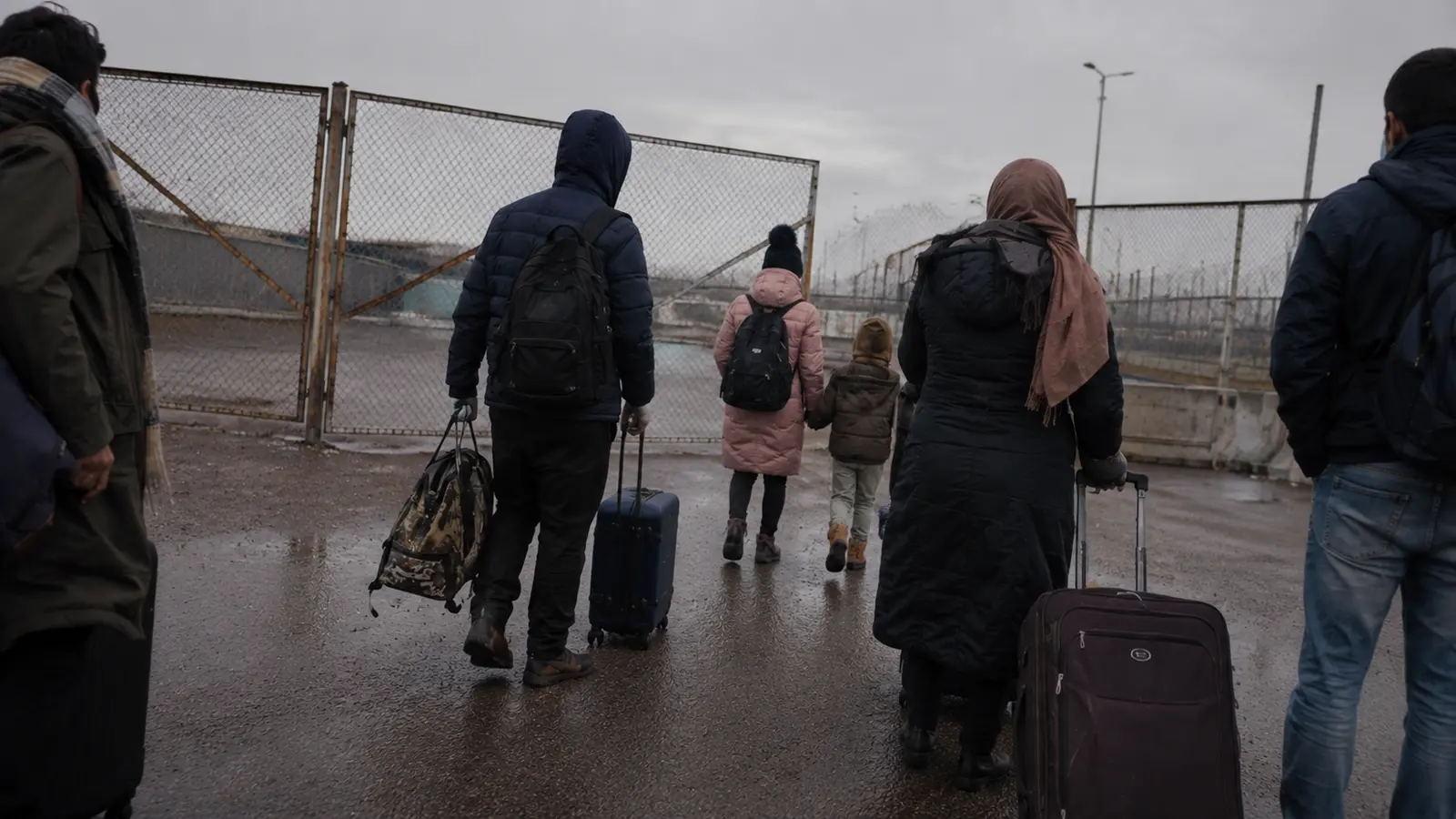
In recent years, Erdoğan has repeatedly wielded an effective weapon with which he has been able to frighten Europe: the weapon of immigrants. This weapon is quite different from turning a fanatical group of immigrants into murderers, or from fully arming an extremist Islamic group and training fugitives to carry out terrorist acts. This time, the weapon is human beings themselves—people in their bare human existence, victims of war who appear powerless after losing everything.
In the past few days, as the Turkish army in Syria has suffered a fatal blow, Erdoğan has again threatened European countries with this weapon. On the other hand, the Turkish president can claim that Turkey has voluntarily hosted several million immigrants on its territory, offering them shelter and financial support. This means, as Turkey claims, that it has extended hospitality to strangers who left their lands and became homeless because of war and disaster.
Now these strangers have once again become hostages, to be used within a logic of exchange with Europe—and with the West in general—with the aim of forcing Europe to accept deals it would otherwise reject in Turkey’s favor. If Europe chooses the other option, opening its doors to immigrants, then Europe itself becomes a hostage to them. From the European Union’s perspective, this is not a rational choice; Europe would rather be hostage to a deal with Turkey than become a hostage in its own home. Yet Turkey, in turn, also risks becoming hostage to the immigrants. This is a strange and complex logic: a logic of becoming-hostage on more than one side.
Philosophy has already spoken about this paradoxical logic of the game—or war—of hostages. For a Jewish philosopher such as Emmanuel Levinas, the ethical and political connotations of strangeness compose a first philosophy in which Being is no longer revealed as the ontological hinterland of the subject, but as the human condition of responsibility toward the Other: the neighbor, the stranger, or even the hostage—in Levinas’s terms, the absolute Other.
At the same time, the absolute Other is revealed to me as unfamiliar and uncanny. I do not know him, perhaps because we have nothing in common: he is of a different race, speaks a different language, believes in another religion, and follows different rules and customs. He comes to me as an uninvited guest, as someone homeless or merely passing by. Perhaps he is a fugitive, perhaps he is hungry, or perhaps even a criminal; nevertheless, he enters my house and shakes my ego. I must then deal with this new situation and with this stranger who has broken the sanctuary of my home.
The immigrant is all of these things, but when he comes to me, he is naked, exposed, and unguarded. According to Levinas, Being is responsibility toward this destitute face of the Other, especially with regard to the violent death of the Other. This is the moment in which the death of the Other accuses me and makes my ego feel ashamed in its castle; such a moment casts light on migration and deadly loneliness as an eternal displacement that makes me hostage to the bare face of the Other.
The face in Levinas’s philosophy is signification: “The Face is signification, and signification without context. I mean that the Other, in the rectitude of his face, is not a character within a context.” In other words, the face is the defenseless, solitary, and expelled face of the Other, able to call to me without language or words, because the face itself speaks: “Face and discourse are tied together. The face speaks. It speaks, it is in this that it renders possible and begins all discourse.”
Through this speech, which is at the same time a call, the Other becomes familiar to me—or becomes my neighbor—obliging me to assume a duty and respond to his demands. In doing so, he reminds me of my responsibility. In Levinas’s view, the Heideggerian phrase that we are “fallen into the world” means that we are “expelled into the world.” We are strangers, able to dwell and live only as guests; for precisely this reason, we are not possessors of the world.
In this sense, the world becomes a central dwelling for welcoming and accommodating the Other. We cannot understand the world if we do not see it as the ultimate possibility of welcoming whoever is to come: the Other. This is why the world is essentially no one’s property, especially in a time of human crisis and when confronting the problem of migration. The world belongs to strangers; it belongs to those already on their way toward us. Richard Sennett argues that the city—or the world—is a society of strangers, a place of shelter where strangers meet.
But is it really true that cities have no owners? Are capitalists not the owners of the world? Actually, no: capitalists have occupied the world. They are taking over the cities and our planet. If we recognize the world as the property of capitalists, it means that we have already surrendered it to them. Yet even in this situation, the world remains without an owner. They take over the world, but they cannot impose absolute sovereignty upon it. They cannot take it away from strangers, because the world is fundamentally an exile and belongs to foreigners. Here again, we can destabilize their security in a different way. The world, in fact, has no stable owner.
Jacques Derrida explained this logic of possession and dispossession as follows. At first sight, it seems that every home has an owner or master, but the essence of the home lies neither in possession nor in property; it lies in the possibility of hospitality. Sometimes it is the home itself, rather than the master, that invites someone in. When a foreigner arrives and enters a house, he imposes the duty of hospitality upon the home and its master. He makes himself a guest. This stranger may save the master and liberate the power of his host. It is as if the master, qua master, were a prisoner of his place and his power, of his identity, and of his subjectivity—his subjectivity is hostage.
“So it is indeed the master, the one who invites, the inviting host, who becomes the hostage—and who really always has been. And the guest, the invited hostage, becomes the one who invites the one who invites, the master of the host. The guest becomes the host’s host. The guest (hôte) becomes the host (hôte) of the host (hôte).”
In this complex game, which resembles a frightening experience, all its elements—the master, the home, and the guest—become a host, a host of a host, or a host’s host.
For Levinas, love is also an ambiguous relationship between hosts—or, more precisely, between hostages. One loves someone who has hosted him. As Jacques Derrida claims, the host, or loving person, ultimately becomes hostage to the love of the beloved, the visiting stranger, destructively cancelling every prospect of possessive ownership.
What calls us to hospitality is love, but we cannot reduce the beloved to an object of sex or authority. The lover initially desires the beloved, but instead becomes possessed by the beloved; he becomes the beloved’s prisoner and hostage. I become the prisoner of the Other. At the same time, the Other exercises sovereignty only when I become his hostage through loving him. If I withdraw myself from his love, then he no longer has any individual sovereignty. In this way, he becomes a prisoner of my presence: he becomes hostage to me as a prisoner, or the hostage of a hostage. I regain my sovereignty, but only as a hostage.
Levinas goes beyond the Hegelian dualism of the relationship between master and slave and replaces it with a multidimensional relationship between host and guest in the sphere of hostage-ship. “The absolutely foreign alone,” says Levinas, “can instruct us. And it is only man who could be absolutely foreign to me—refractory to every typology, to every genus, to every characterology, to every classification.” Thus, the Other—the absolute Other, who is yet without character—is a precondition of my subjectivity and can once again constitute my responsibility for another.
Hospitality, as an ambiguous ethical act and as love or hostage-ship, is a philosophy of exteriority, exile, and eternal homelessness. It is commiseration with Others who are on the road; at the same time, it is the song of strangeness as an ethical and cosmopolitan experience.
Today, in relation to Turkey’s hostile actions, we can say that Erdoğan is taking advantage of the circumstances of immigrants and turning them into a human weapon. At the same time, he claims, in the name of love and humanity, that his country has acted in accordance with human rights, offered hospitality to suffering people, and welcomed foreigners who might otherwise have entered Europe had they crossed Turkey’s borders.
Yet he also treats immigrants as hostages and transforms them into a weapon. Turkey, too, as the host country, sees its sovereignty and security placed under threat by immigrants. This means that Turkey becomes a hostage to these strangers, whom it in turn views as hostages to be used to frighten countries that fear becoming hostages in their own homes.